
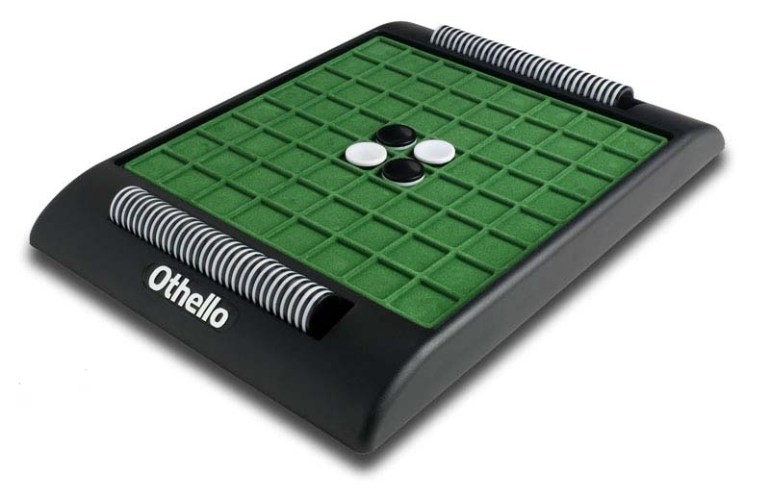
Historical Context: The game of Reversi was patented in 1888, though it strongly resembles an earlier game of 1870, Annexation, on which it was probably based. This product of the Victorian board game was popular until World War I, after which it was largely forgotten. In 1968 the game was reinvented in Japan, as Othello. Since then it has gained immense popularity, at first in Japan. More recently it has been a popular subject for programmers of computers and mobile phones, spreading its popularity across the world. Although there is no formal proof of the game’s origin, two places have been suggested from its invention. One is China, from a game called ‘Fan Mian’, the other is from Lewis Waterman and John W. Mollett in 1888, who made this game available. In about 1970, Goro Hasegawa, a Japanese developed the modern rules of Othello,
Reversi, commercially known as Othello since the 1970s, is a game of placement and capture. The game starts with four pieces in the center of the board, two of each colour which. Players place pieces one at a time, capturing rows of opposing pieces that are sandwiched between the newly-placed piece and other friendly pieces around the board. Pieces are black on one side and white on another; a captured piece is turned over to show its opposite colour.
Links:
http://www.archimedes-lab.org/game_othello/othello.html

